Roofing insight
Seamless Gutter Sizing for Heavy Rain in Louisiana
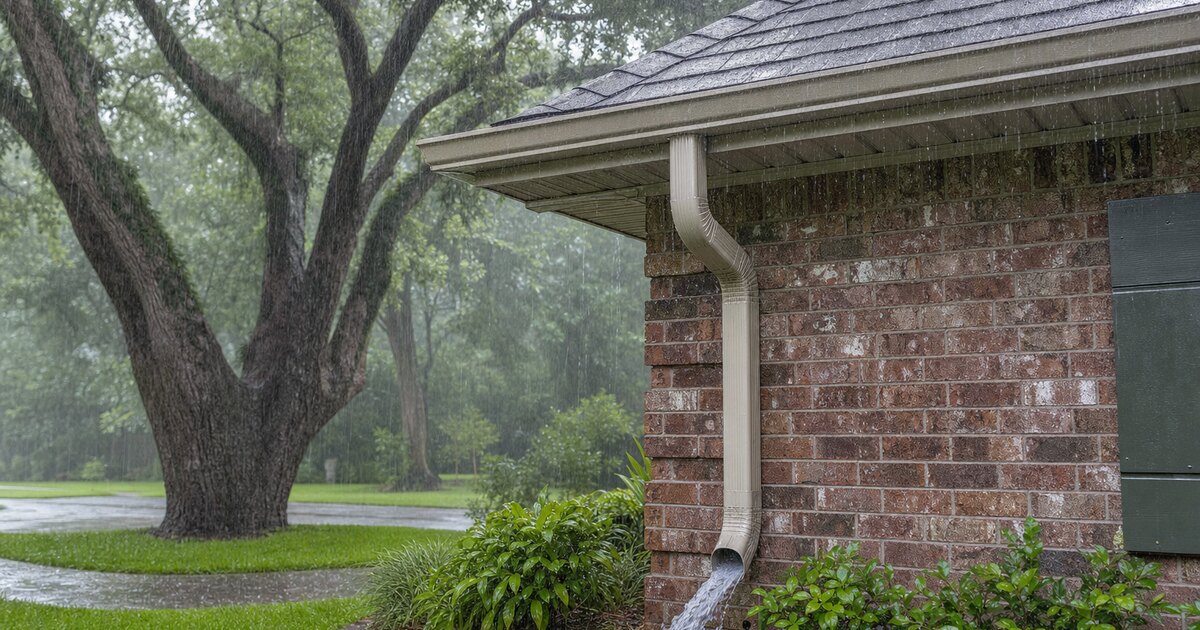
Seamless gutter sizing for a Louisiana home depends on the roof area draining to each run, roof pitch, valleys, inside corners, local rainfall design, gutter profile, slope, outlet count, and downspout capacity. A wider gutter alone cannot fix too few outlets, undersized downspouts, poor pitch, blocked discharge, or water directed toward the foundation.
Roofs Restored installs 5-inch, 6-inch, and 7-inch gutters in South Louisiana. The correct size must be calculated for the house rather than selected from one statewide rule.
What Information Is Needed to Size a Gutter System?
A gutter installer needs the roof plan, drainage areas, pitch, concentrated-flow points, available run lengths, outlet locations, downspout routes, and discharge conditions. Each roof section should be assigned to a gutter run so the estimate reflects how water actually reaches the eaves.
Record these factors:
- Horizontal roof area draining to each gutter run.
- Roof pitch and material.
- Valleys or upper roofs that concentrate water.
- Run length and required slope.
- Number, size, and location of outlets.
- Downspout size, route, elbows, and discharge point.
- Trees and debris that affect cleaning frequency.
- Fascia, drip-edge, and roof-edge condition.
Are 5-Inch, 6-Inch, or 7-Inch Gutters Best for Heavy Rain?
No single width is best for every house. A 5-inch gutter may serve a small, simple drainage area with adequate outlets, while a 6-inch or 7-inch system may provide more capacity for a larger or more concentrated flow. The downspouts and outlet layout must increase with the gutter where needed.
| Size question | Why it matters |
|---|---|
| How much roof drains here? | Capacity should match the contributing roof section, not total home floor area |
| Does a valley end at this run? | Valleys can concentrate water into a short section |
| How long is the run? | Long runs need suitable slope and outlet placement |
| How many downspouts fit? | More or larger outlets may relieve overloaded runs |
| Where can water discharge? | A large gutter still fails the property if discharge returns to the foundation |
Ask the installer to show why the proposed width and downspout layout fit each elevation.
How Should the Design Rainfall Be Selected?
Gutter sizing should use precipitation intensity for the property's location and selected design event, not a statewide average. NOAA's Atlas 14 Precipitation Frequency Data Server for Louisiana provides point estimates by address, coordinates, or weather station for multiple storm durations and recurrence intervals.
The 2021 International Plumbing Code storm-drainage chapter illustrates how roof drainage capacity is tied to design rainfall. The code edition and method that apply to a house must be confirmed with the local authority. The installer should then match the selected intensity and contributing roof area to published capacity information for the exact gutter profile, slope, outlets, and downspouts.
A useful sizing record should state:
- The property location and rainfall source used.
- The selected storm duration and recurrence interval.
- The roof area assigned to each gutter run.
- Any pitch adjustment or concentrated flow from valleys and upper roofs.
- The published capacity used for the gutter profile, slope, outlets, and downspouts.
- The discharge route and any grading or underground-drain limits outside the gutter scope.
This information makes a 5-inch, 6-inch, or 7-inch recommendation reviewable without treating one online formula as a final design for every house.
Why Do Gutters Overflow Even When They Look Large Enough?
Gutters overflow when water or debris exceeds the capacity of the weakest part of the system. Common restrictions include a small outlet, clogged downspout, insufficient slope, too few downspouts, a valley discharging past the gutter, or a run that has pulled away from the fascia.
Inspect these points before replacing the entire system:
- Leaves, pine needles, roof granules, and shingle pieces
- Standing water that indicates poor slope
- Leaking end caps, corners, and outlets
- Loose hangers or damaged fascia
- Downspout elbows blocked by compacted debris
- Splash blocks or underground drains that back up
- Erosion or ponding at discharge points
Ready.gov includes clearing drains and gutters among its hurricane preparation steps. Cleaning should be done from a safe access method; wet roofs and unstable ladders create fall hazards.
Do Seamless Gutters Eliminate Leaks?
Seamless gutters reduce field joints along straight runs because each run is formed to length. They still have joints and sealants at corners, end caps, outlets, and transitions. Hangers, pitch, fascia condition, downspouts, and discharge remain just as important as the absence of mid-run seams.
Choose between K-style and half-round profiles based on verified capacity, attachment, appearance, maintenance, and accessory compatibility. A style name alone does not establish drainage performance.
How Should Downspouts Be Planned?
Downspouts should move water from the gutter without creating a bottleneck and should discharge where water can continue away from the building. Their number and size depend on the contributing roof area, gutter run, outlet geometry, elbows, and available discharge routes.
Ask where every downspout ends. Water should not be released onto a walkway, against siding, beside a low foundation area, or into a blocked underground line. Drainage beyond the downspout may require grading, piping, or another qualified trade outside the gutter installation scope.
Are Gutter Guards Helpful in South Louisiana?
Gutter guards can reduce the amount of larger debris entering a system, but they do not make gutters maintenance-free. Pine needles, seeds, roof granules, pollen, and fine debris can collect on or below different guard types. Heavy rain can also overshoot a poorly selected or clogged guard near valleys.
Compare opening size, cleanout access, roof attachment, valley behavior, manufacturer instructions, and the types of trees near the house. Schedule inspections after severe weather and when overflow appears.
What Should a Seamless Gutter Estimate Include?
A complete estimate should identify gutter profile and width, metal and thickness, hanger type and spacing, slope, outlets, downspout size and count, corners, end caps, sealants, fascia repairs, guards, disposal, and discharge limits.
It should also state:
- Which roof areas drain to each run
- Why each run uses the proposed size
- Where valleys need special attention
- How water leaves each downspout
- Which existing drainage or grading problems are excluded
- What cleaning and inspection the system requires
Review Roofs Restored's seamless gutter installation and repair services, then compare gutter work with patio cover drainage planning when both roofs meet at the same exterior area.
Who Installs Seamless Gutters in South Louisiana?
Roofs Restored in Hammond installs and repairs K-style and half-round gutters, leaf guards, commercial systems, and 5-inch, 6-inch, and 7-inch options in South Louisiana. The company is licensed and insured, has more than 20 years of industry experience, and provides free inspections and same-day estimates.
Request a free gutter estimate or call 985-222-2647 for a property-specific drainage layout. Ask the estimator to show the roof areas, rainfall source, gutter and outlet capacity, downspout routes, fascia findings, cleanup, and drainage exclusions used in the written scope.
Sources Reviewed August 14, 2026
- NOAA National Weather Service, Atlas 14 Precipitation Frequency Data Server for Louisiana
- International Code Council, 2021 International Plumbing Code, Chapter 11: Storm Drainage
- Ready.gov: Hurricanes, updated July 9, 2026
- U.S. Department of Energy Building America Solution Center, Metal Roofs, including roof-to-gutter drainage guidance
- Roofs Restored, Seamless Gutters in South Louisiana