Roofing insight
Patio Cover Planning for Louisiana Storms
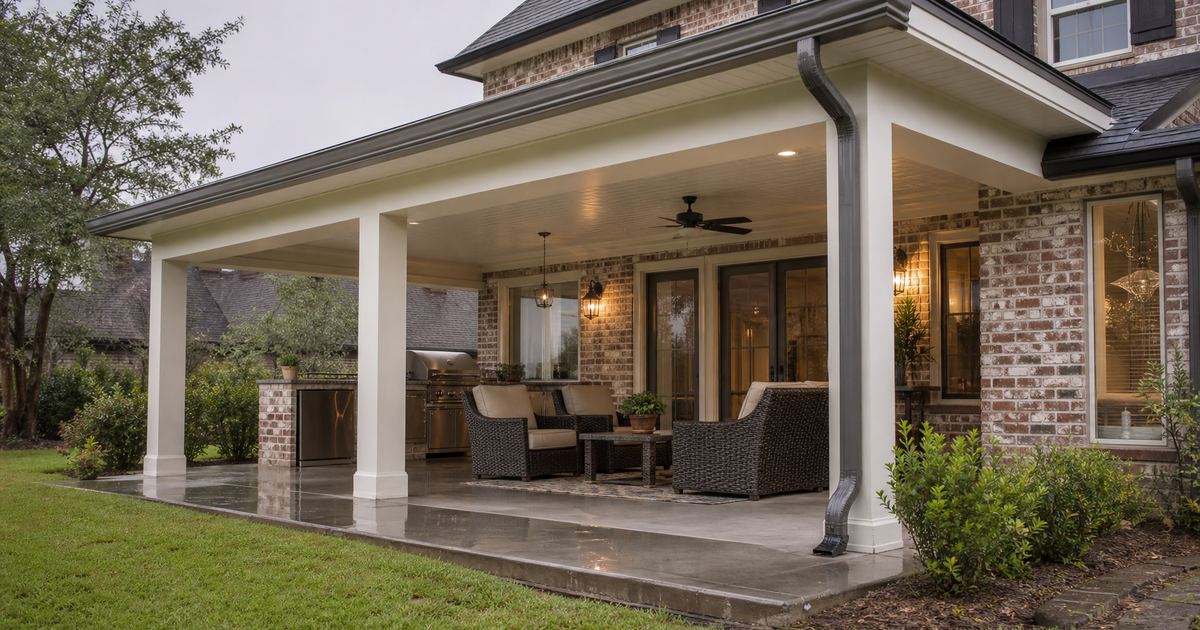
Plan a South Louisiana patio cover as a complete outdoor roof system, not a panel purchase. The estimate should document the intended use, dimensions, roof slope, supports, footings, house attachment, flashing, gutters, downspouts, final drainage route, and local approval responsibilities. Roofs Restored in Hammond installs insulated and non-insulated patio covers for homes and businesses across South Louisiana.
What Should a Patio Cover Handle During Rain and Wind?
A patio cover needs a documented path for water and a support system that matches the proposed site and design. Rain can concentrate at the house connection, roof transitions, valleys, and short gutter runs. Wind acts on the roof, framing, posts, footings, and any house attachment as a connected assembly, so one material label does not establish how a completed cover will perform.
Start with these project questions:
- Is the cover attached to the home or freestanding?
- What roof panel or roof covering, framing, posts, beams, and footings are proposed?
- How will flashing and sealants control water at an attached wall or roof?
- Where will the patio-cover roof water enter a gutter, downspout, or final discharge route?
- Which design documents, permits, inspections, and association approvals apply to this property?
The patio cover services page outlines the site conditions Roofs Restored reviews before defining an estimate. Do not assume an existing slab, wall, or gutter layout will accept a new cover without inspection.
How Should Patio Cover Drainage Be Planned?
Drainage starts at the roof surface and ends at the final discharge point. The layout should show the roof slope, gutter profile, outlets, downspouts, and the route water takes away from the cover and home. Existing house gutters may need review if the new cover adds roof area or concentrates water at one location.
| Drainage detail | Why it belongs in the scope |
|---|---|
| Roof slope | Establishes the direction water is intended to travel |
| House connection and flashing | Addresses the transition where an attached cover meets the existing structure |
| Gutter and outlets | Collect and direct roof water from the cover |
| Downspouts | Move water from the gutter to the planned discharge area |
| Final discharge route | Helps prevent water from returning toward the house or a walking surface |
| Existing roof runoff | Identifies upper roof or valley flow that may reach the cover or gutter |
Review the seamless gutter sizing guide for heavy Louisiana rain when the new cover will connect to a gutter system. The National Weather Service provides NOAA Atlas 14 precipitation frequency estimates by location for design reference; a project-specific drainage plan still depends on the property layout.
Should You Choose an Insulated or Non-Insulated Patio Cover?
Choose between insulated and non-insulated roof panels by comparing the proposed system, the desired ceiling finish, heat-transfer priorities, span and attachment requirements, drainage, electrical planning, maintenance, and written price. An insulated panel can reduce heat transfer through the panel compared with a similar non-insulated assembly. Neither option guarantees a specific patio temperature because shade orientation, airflow, humidity, surrounding surfaces, and time of day also affect comfort.
For a full comparison, read insulated versus non-insulated patio covers in Louisiana. If insect reduction and an enclosed outdoor space are the goal, compare the structure with a South Louisiana screen room before approving the layout.
What Should You Verify Before Construction Starts?
The most useful proposal names the materials and responsibilities rather than promising a generic storm-ready result. Before work starts, ask for:
- Overall dimensions, roof height, slope, and attached or freestanding layout.
- Roof-panel or roof-covering specification, framing, posts, beams, footings, and fasteners.
- House attachment, flashing, sealant, gutter, downspout, and discharge details.
- Planned electrical allowances, lighting, fans, or other work by the appropriate trade.
- Engineering, permit, inspection, and association-review responsibilities.
- Cleanup, schedule assumptions, warranty documents, exclusions, and the change-order process.
The Louisiana State Licensing Board for Contractors offers contractor search and consumer resources. Confirm local permit and inspection requirements with the authority having jurisdiction, because requirements can differ by property and scope.
How Can Roofs Restored Help With a Patio Cover?
Roofs Restored in Hammond installs insulated and non-insulated patio covers for South Louisiana homes and businesses. The licensed and insured company has more than 20 years of industry experience and provides free inspections within 24 hours and same-day estimates. A property visit can establish the proposed use, roof transition, support layout, drainage route, and scope details before work is priced.
Request a free patio cover estimate or call 985-222-2647. Ask the estimator to identify the roof panel or roof covering, framing, attachment, drainage, approvals, warranty documents, and exclusions in writing.
Sources Reviewed September 21, 2026
- Roofs Restored, Patio Covers in South Louisiana
- Roofs Restored, Insulated vs. Non-Insulated Patio Covers in Louisiana
- NOAA National Weather Service, Atlas 14 Precipitation Frequency Data Server
- Louisiana State Licensing Board for Contractors, Contractor Search and Consumer Resources