Roofing insight
Standing Seam vs. Exposed-Fastener Metal Roofs
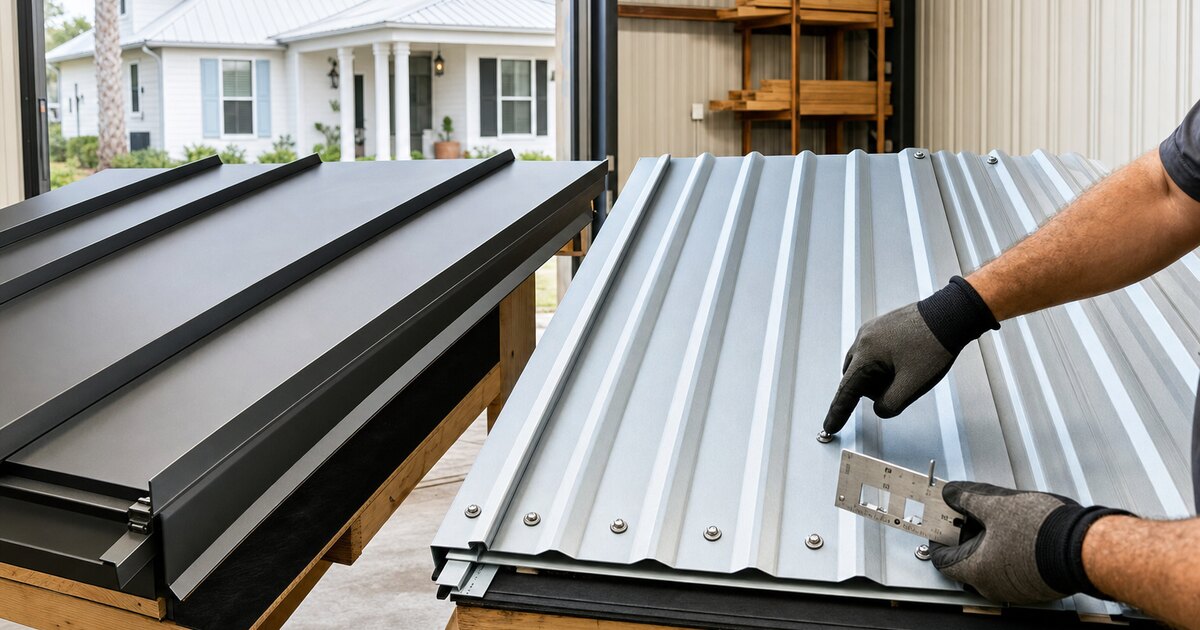
Standing-seam metal roofing conceals most field fasteners beneath raised seams, while exposed-fastener panels use gasketed screws through the panel surface. Standing seam often offers fewer exposed penetrations and more room for thermal movement. Exposed-fastener panels can have a lower initial scope. The tested assembly, deck, slope, coating, attachment, and installer still determine performance.
For a South Louisiana home, compare complete systems rather than assuming every standing-seam roof is stronger or every exposed-fastener roof is cheaper over its full service period.
What Is an Exposed-Fastener Metal Roof?
An exposed-fastener roof uses ribbed metal panels secured with screws driven through the panel into the deck, battens, purlins, or framing specified by the system. Each screw and sealing washer remains exposed to sun, rain, temperature changes, and inspection.
The U.S. Department of Energy's Building America metal roof guide describes exposed-fastener panels as factory-made ribbed sheets commonly attached with color-matching gasketed screws. Installation quality depends on correct screw material, spacing, alignment, and washer compression. Angled, underdriven, or overdriven fasteners can create problems.
What Is a Standing-Seam Metal Roof?
A standing-seam roof uses vertical panels with raised seams and concealed clips or fasteners. Panels commonly run continuously from eave to ridge. Snap-lock and mechanically seamed profiles join differently, and each product has its own deck, slope, clip, seaming, and uplift requirements.
Concealed attachment can reduce the number of exposed washers and allow designed panel movement. It does not remove the need for correct flashing, edge details, clips, fasteners, underlayment, deck attachment, and maintenance.
How Do the Two Metal Roof Systems Compare?
| Decision factor | Exposed fastener | Standing seam |
|---|---|---|
| Field attachment | Screws penetrate the visible panel surface | Clips or concealed fasteners sit below the seams |
| Thermal movement | Panel length and screw details must manage movement at penetrations | Clips may permit designed movement, depending on the system |
| Routine inspection | Exposed screws and washers are recurring inspection points | Seams, clips where accessible, flashing, sealants, and panel movement remain important |
| Deck options | Some tested systems permit solid deck or spaced supports | Commonly requires solid sheathing; verify the exact system |
| Initial price | May have a lower initial installed scope | Often has more specialized fabrication, clips, and seaming work |
| Wind performance | Depends on tested panel, fasteners, spacing, deck, and edge zones | Depends on tested panel, seams, clips, spacing, deck, and edge zones |
The roof name is not the test result. Ask for the current evaluation report or product approval that matches the exact panel width, metal thickness, clip or screw spacing, substrate, and roof zones.
Which System Is Better for Louisiana Wind and Rain?
Neither system is automatically better for every Louisiana home. The selected assembly must provide suitable uplift resistance for the property's design pressures and exposure. Roof edges and corners can require different attachment from the field of the roof. Water performance also depends on slope, seam or lap design, underlayment, flashing, and drainage.
DOE's guide says standing-seam panels are highly resistant to wind and wind-driven rain when selected and installed correctly. It also documents failures where concealed clips were placed incorrectly. Exposed-fastener systems can perform when their tested attachment and maintenance requirements are followed.
For coastal exposure, review metal roofing for coastal South Louisiana, including salt-distance limits, compatible metals, coatings, and fastener selection.
Which Metal Roof Needs More Maintenance?
Exposed-fastener systems generally put more visible screws and sealing washers into the inspection plan. Standing-seam systems reduce exposed field penetrations but still require checks of seams, clips where accessible, flashing, sealants, penetrations, edges, coatings, debris, and drainage.
Maintenance frequency should follow the manufacturer and actual exposure. After severe weather, observe from the ground and arrange a professional inspection when panels, trim, seams, flashing, or drainage appear changed. Never apply an unknown sealant or replacement screw without confirming compatibility.
How Should You Compare Metal Roof Cost?
Compare the same roof area, tear-off, deck repair, underlayment, flashing, ventilation, trim, coating, attachment, permit, and cleanup scope. A lower exposed-fastener bid may leave more future inspection points. A higher standing-seam bid does not guarantee lower ownership cost without a realistic maintenance plan and documented assembly.
Use the South Louisiana roof replacement cost guide to compare line items. Include likely inspection, cleaning, repair, and replacement costs over one common study period rather than comparing material price alone.
What Should a Metal Roof Proposal Include?
Require these details in writing:
- Panel manufacturer, profile, width, thickness, substrate, coating, and color.
- Deck type and condition.
- Underlayment, eave, valley, wall, penetration, and ridge details.
- Screw or clip material, type, spacing, and roof-zone pattern.
- Current test report, allowable pressures, and installation instructions.
- Coastal corrosion restrictions and compatible accessory metals.
- Product and workmanship terms, exclusions, and maintenance requirements.
- Complete installed price and concealed-damage process.
What Should You Confirm Before Metal Roof Work Starts?
A complete proposal should also explain how the project will affect the property. Confirm driveway and yard access, where panels and removed materials will be staged, how landscaping, siding, windows, and outdoor equipment will be protected, and who will be the on-site contact.
Ask for written expectations covering:
- Safe vehicle, pet, and household access during the work
- Tear-off debris, panel handling, daily cleanup, and final magnetic sweep where applicable
- Weather delays and how an exposed roof will be protected
- Material-delivery and equipment locations
- Concealed deck damage, change-order approval, and schedule changes
- Final walkthrough, installed-product records, and maintenance instructions
Which Metal Roof Systems Does Roofs Restored Work On?
Roofs Restored installs, reroofs, and repairs metal roofing systems across South Louisiana. The licensed and insured team evaluates the panel, coating, attachment, flashing, underlayment, and visible deck conditions before preparing a written scope.
Review Roofs Restored metal roof services, then request a free same-day estimate or call 985-222-2647 for a house-specific comparison of standing seam, exposed-fastener panels, and available alternatives.
Sources Reviewed August 5, 2026
- U.S. Department of Energy Building America Solution Center, Metal Roofs
- FEMA, Metal Roof Systems in High-Wind Regions, 2009
- IBHS FORTIFIED, Technical Documents